MUST-SEE CREMATION CEREMONY OF 2 ROYALS IN BALI
WHAT IS A CREMATION PROCESSION IN BALI?
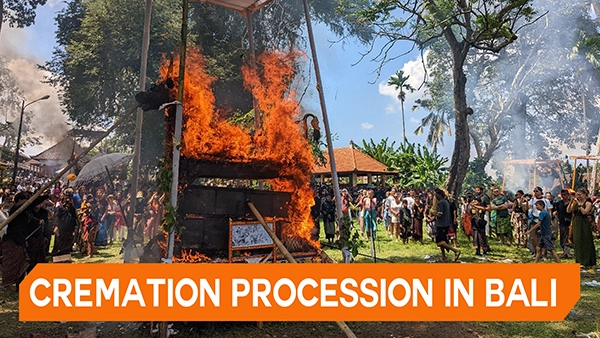
The cremation procession, locally named, Ngaben, is one of the most important ceremonies in Balinese Hinduism. It’s a centuries-old spiritual tradition culminating in the cremation of the deceased body. This procession is one of the most beautiful ceremonies in Bali and the most important one in the life of a Balinese.
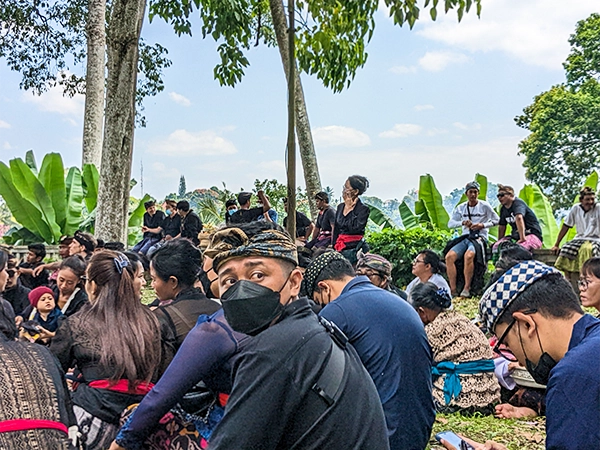
This type of ceremony is open to the public and locals welcome the tourists that show interest in the procession. But honestly, I saw some tourists that were not very conscious of the meaning of this procession and were walking freely everywhere, without minding the procession, disturbing the locals. Despite that, the locals were always smiling, they were the ones getting out of the way of the tourists that were even walking over the graves that were there without any remorse. Personally, I was shocked by this behavior and by how nice the Balinese were, knowing they were cremating a member of their family.
I was so blessed to be able to participate in this event in the first place, but I never expected to meet Agung, who shared his deep knowledge about the Cremation Ceremony and Balinese culture. I was not ready for an interview, this was not at all an interview. I was just filming with my phone when Agung saw me and he approached. As I did not have the proper gear for an interview, not even a microphone, it was very hard to get on tape everything that Agung was saying. That’s why I kept repeating what he said. You will hear my voice a lot in the video.
Check below the entire procession and the discussion (let’s not call that an interview, ok?) I had with Agung.
HOW DOES BALI CELEBRATE THE CREMATION CEREMONY?
Ngaben literally means ‘turning into ash’. During this expensive ritual, the spirit is guided into its next life by a bull and it’s considered a celebration. The Ngaben processions are often colorful and noisy. The day of the cremation must be held on a Good Day and is chosen by a priest, according to the Balinese calendar.
As Agung said during our discussion, the ceremony costs a lot, and some families have to save for a long period to afford this. They have a mass cremation ceremony every five years to share the costs, or private cremation like this one, with 6 people maximum. After dying, the dead bodies are put into the ground while waiting for the cremation. And after they will take them out from the ground.
Before the cremation, the body is cleansed and given symbolic amenities to make sure the spirit will receive a perfect body in the next life. The elders and priests will then pray for the soul of the deceased, asking for a smooth journey to the other side.
Agung was telling me that the Balinese people believe humans come from five elements, which are pertiwi (earth), apah (water), teja (fire), bayu (air), and akasa (ether).
When you die, these five elements must be returned to their place of origin.
The majority of Bali’s population follows Hinduism. For Balinese Hinduism, life is a cycle of birth, death, and rebirth, which can only be broken when the soul is pure enough to be reunited with the Gods. To reincarnate, the soul must be released through the cleansing fire of cremation.
Caste System in Bali – Brahmana, Ksatrya, Wesya and Sudra
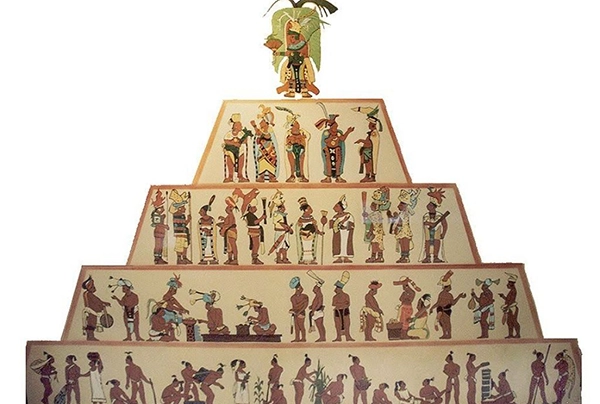
I’ve also learned from Agung that they have a complex system of Social Hierarchy, divided into four castes:
1. The Brahmanas (Brahmin) – the priest’s caste
Considered to be descendants of Pedanda Wawu Rauh or also known as Dang Hyang Nirartha the founder of the Shaivite priesthood in Bali. The Balinese from this caste will always have names like Ida Bagus (male) and Ida Ayu/ Dayu (female).
2. The Ksatrya – the caste of warriors, nobilities, and kings
This caste is strongly related to the Gelgel Kingdom in Bali (now Klungkung) conquered by Meruti, a king sent by Erlangga (Balinese king of the Kediri Kingdom in Java). After claiming the territory of the Gelgel kingdom, Meruti established one of his loyal fellows with the title Dewa Agung. Dewa Agung had two children named Tjokorda and Anak Agung, and these titles remained until today.
3. The Wesya, the caste of the merchants and administrative officials.
People in this caste have names Gusti, Ngurah, Dewa, and Sang.
4. The Sudra – the outsiders, “the jaba” or the commoners’ caste
This caste represents 93% of Bali’s population. The beginning of Sudra names indicates the order of birth (same for male and female): Wayan or Putu for the first child, Made or Kadek for the second child, Nyoman or Komang for the third child, and Ketut (meaning “the last one”) for the fourth child.
TYPES OF CREMATION CEREMONIES IN BALI
As you will see in the video, each dead body is transported on a Ceremonial Tower, and a Bull.
The levels of the Ceremonial Tower depend on the caste of the deceased.
The Ceremonial Tower, locally called Waddhu, or Bade, has multiple levels and is made from bamboo, wood, and paper.
These towers are brightly colored with fantastic designs because for them this is a celebration.
As you can see in the video, the Waddhu is carried during the funeral procession and turned around multiple times to discourage the spirit from lingering.
The coffin contains the deceased, but sometimes it can contain only the ashes and is transported inside the ceremonial tower. Alongside the Wahhdu, there is also a Lembu (meaning Ox), which can be either an Ox, a Bull, or another animal, and a local will ride the animal made of wood and paper and carried on the elbows by the rest of the community.
The upper part of the animal can be detached as is inside the belly of the Ox that the body will be put before the cremation.
For the upper castes and the royalty, the ceremony is called Pelebon and is even more extravagant.
The Waddhu has nine floors to signify its high status in society and the family hires also an orchestra of percussion, named Gamelan.
The word Gamelan is a Javanese word meaning “strike with a hammer”. The Gamelan will escort the funeral procession, contributing to the noisy, festival atmosphere.
Once the procession reaches the place of the cremation, a priest lights the fire to burn the Lembu and the Waddhu. Afterward, the community lays down in a circle to share food and drink.
CHECK OUT THE BEST ACTIVITY TOURS IN BALI
DID YOU FIND THIS ARTICLE USEFUL?
Tell me in the comments section if you’ve been to Bali and what was your experience. If you are planning to go on solo travel to Bali ask me for some useful tips that are not in this article.
FOR MORE TRAVEL INSPIRATION, FOLLOW ME ON
DON'T MISS OUT ON THIS

Travel Guide to Bali
TRAVEL GUIDE TO BALI THE BEST TIME TO VISIT BALI Situated in the Asian continent, Bali is a province of Indonesia situated in the western part of the Lesser Sunda Islands. It is situated 1 mile, or 1.6 km east of […]

Must-Do Activities in Bali: Tegallalang Rice Terrace
MUST-DO ACTIVITIES IN BALI: TEGALLALANG RICE TERRACE IS IT WORTH IT TO VISIT TEGALLALANG RICE TERRACE UBUD? Tegallalang Rice Terrace is part of the UNESCO World Heritage list. Because of its beauty and uniqueness, is one of the most popular […]

20 most instagramable places in Bali
20 MOST INSTAGRAMABLE PLACES IN BALI Even though Bali is the most instagramable island on earth, there are a few locations you should definitely put on your bucket list. Your Instagram feed and your Pinterest board will fire up for […]
My Experience as a Solo Female Traveler in Bali
My experience as a solo female traveler in Bali Going on a Solo Trip, especially as a female traveler can be overwhelming. I’ve been on so many Solo Travels that you would think I got used by now. But when […]

How to prepare Balinese dish Bubur Injin
HOW TO PREPARE BALINESE DISH BUBUR INJIN INDULGE IN THE BALINESE CUISINE Balinese cooking is a plethora of cultural influences. Balinese dishes, cooking styles, and tools for preparing food have been cultivated from other cultures. The Chinese introduced stir-frying, […]

Travel Guide to Indonesia
TRAVEL GUIDE TO INDONESIA This is your ultimate travel guide to Indonesia! CAPITAL: JAKARTA Asia is my favorite continent, where I would go over and over. It is so diverse, so full of history, cultural diversity, paradisiaque landscape, and scenery you […]

How to prepare Balinese dish Gado-Gado
HOW TO PREPARE BALINESE DISH GADO-GADO INDULGE IN THE BALINESE CUISINE Balinese cooking is a plethora of cultural influences. Balinese dishes, cooking styles, and tools for preparing food have been cultivated from other cultures. The Chinese introduced stir-frying, the […]

How to prepare Balinese dish Pisang Goreng
HOW TO PREPARE BALINESE DISH PISANG GORENG INDULGE IN THE BALINESE CUISINE Balinese cooking is a plethora of cultural influences. Balinese dishes, cooking styles, and tools for preparing food have been cultivated from other cultures. The Chinese introduced stir-frying, […]
BALI FOOD